
Moderate levels of uncluttered sound reveal harmonics and timbres that are missed when we push a room and our ears beyond their limits.
We are lucky if we survive childhood with most of our hearing intact. Sporting events, concerts, cranked up earbuds and other explosions of sound all do a number on our fragile ears. On average, Americans listen to music on headphones at rates that can drift into a red zone of 94 to 105 dB At bustling New York restaurants it is common for a food reviewer to report that they cannot hear what their server is saying. These sound levels are akin to standing near the end of the runway of an American airport. Our current problem is that original equipment we were born with evolved to detect sound typical of a conversation than the roar inside a modern sports arena. Teens are especially attracted to the energy of noise, which I suspect stands in as a kind of token of independence.
Like other mammals, we were meant to aurally detect whispers, or the sounds of leaves underfoot, or the snap of a peapod when it is ready to yield the seeds inside. Nature decidedly did not evolve our hearing for the mayhem of a modern ballpark on a Saturday afternoon, or the output of a Fender 435-watt amplifier.
As as been said many times here, sonic overload in modern life is a problem. So is the assumption that listening is a throwaway skill. We don’t think we need to learn to listen, or to take steps to preserve our hearing. But most older adults who have clocked more than a few decades might tell you that an owner’s manual would have been a good idea. A life of listening at fortissimo involuntarily withers to pianissimo in later years, usually requiring electronic assists in middle age in order to still function in the culture.

Not only is hearing easily damaged by loud sounds, but the bones and tissues of the middle and inner ear typically don’t self-repair. In the face of a sound onslaught the best our hearing organs can do is slightly retard the bones of the middle, allowing for just a bit of protection from a sonic assault. Muscles connected to those tiny bones–the smallest in the body–can stretch to dampen loud noises to protect the fragile half-centimeter hair cells of the inner ear. But they are also easily overmatched by modern electrical and mechanical racket.
I started my brief stab as a school and college musician as a drummer, learning to use the musical artillery of a percussionist. But as I have aged, I’ve come to appreciate musical nuance, where moderate listening levels reveal inner sounds like timbres and recording room characteristics that are missed when we push hearing to its outer limits. A good recording played at a moderate level will let you hear the wood of a string instrument, the three-octave spread of singer like Karen Carpenter, or the mellow warmth of Gary Burton’s vibraphone. We were meant to hear the quiet Westminster chimes of Big Ben quietly embedded in Ralph Vaughn William’s London Symphony, as well as the richness of Nathan East’s acoustic bass. Listen live to a pianist on a good piano and you may hear what recordings seldom catch. Even a single note triggers a range of audible overtones on the same instrument.
Overtones or “partials” give all acoustic instruments a wonderful complexity that the ear detects if not overwhelmed by other sounds. Listen to the instruments in this clip: full and rich on their own, but also clearly in a space that functions as another instrument. There is some complex physics going on here that yields beautiful sounds.
It is also a plus to be able to sense the sound of a room. But it is heresy for most recording engineers. They want a “dry” space: acoustically the equivalent of listening to an unamplified solid-body electric guitar. No wonder musicians love the acoustic richness of most performance spaces with natural reverberation.
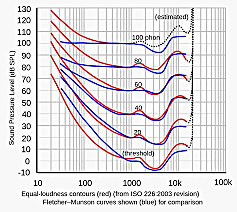 To be sure, very low listening levels can strip music of details and both ends of the sound spectrum. Unlike good audio equipment, our hearing is not stable and flat across all sound frequencies: a pattern sometimes known as the Fletcher-Munson effect. A listener has to find the sweet spot for hearing everything. The best experience is attained when auditory levels are less than Phil Spector’s “wall of sound,” but more than the ubiquitous background music in a public space. At some point in the middle (75 dB, or what a voice or piano in a modest-sized room might produce) quieter overtones emerge, revealing a feast of detail at levels that the ear can handle.
