
No one was going to tell Frank Sinatra to sing inside a tiny vocal isolation booth.
Many managers are not fans of working remotely. They often point out that there is something to learn about the advantages of meeting colleagues in real time and space. The same idea is present in the seemingly distant realm of music-making. Barbara Streisand’s Partners album (2014) famously created tracks pairing Streisand with different performers in sometimes distant studios. The audio engineering is clever, but it doesn’t seem to be an ideal way to make music. As a New York Times critic noted, “the instrumentation and the vocal tracks are so processed in pursuit of a high-gloss perfection that any sense of two people standing side by side and singing their hearts out is lost.”
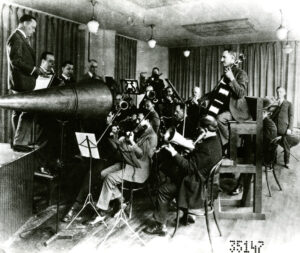 Audio recording has advanced from the days when a small group of musicians would gather around a tiny, elevated platform and try to cast their music into a horn that collected enough sound to cut the vibrations into a wax disk. Recordings before 1920 were made in this awkward but honest way. No electronics were involved. No one phoned anything in. What is heard on those old 78s is the result of the use of a small acoustic space.
Obviously, the evolution of modern electronics changed all of that. Microphones, amplifiers and various gadgets appeared in the audio chain, sometimes adding over-dubs, reverberation and electronic tricks, partly turning recording into a science focused on the engineering of sound.
If the first wave of recording captured musicians in the same space and time, the second wave typically gave us a studio covered by a sea of microphones. But in the 1940s and 50s the goal of an audio engineer was to capture as much as you could, and usually on the musician’s terms. There were probably a few times when a record producer thought of suggesting that Frank Sinatra might get a better recording if he were isolated in a separate booth. But this was the Chairman of the Board, and he clearly wanted to feel the rumble of the Count Basie Band or the lushness of Nelson Riddle’s arrangements.
Even so, less established pop artists began to yield to their producers and engineers who were using newer tools like multi-track recorders and electronic sound “enhancement.” In this third wave the final version of a song or album was an amalgam of live performance later altered by add-ons of strings, backup singers or new tracks with singers harmonizing with themselves. Performers accustomed to live performance were sometimes put off by this piecemeal approach, but soon it was the record rather than the live performance that was the final benchmark of a career. Suddenly a live performance needed to use synthesizers and “backing tracks” to approximate the instruments and performers heard in the original recording. In simple terms, popular recorded music offered an altered soundscape that only gives the illusion of an event captured in one space and time.
Hearing the Room
If we want to hear an unaltered live performance, we have the records of some brave musicians, classical groups, and a smattering of jazz performances. But the “all at once” philosophy in popular music was beginning to die out, leaving examples like Sinatra’s classic Songs for Swinging Lovers recorded in Capitol’s Studio A in 1956. As a photo from the session shows, Sinatra is in front of Nelson Riddle’s band and just a few feet from a Neumann U47 tube microphone. No one was going to tell Sinatra to sing away from the rest of the group.
In that still admired recording engineers had to work to keep the sound of the band from drowning out Sinatra’s voice. But everyone got the benefit of the energy that was evident in the performance. And it offers a tangible sense of space: an open-air ambiance contributed by a room that still exists in Hollywood.
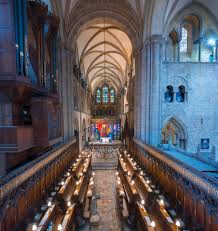 Recording ambiance is part of what makes music in many forms so special. Here’s an obvious case: a clip of Richard McVey playing a well known British anthem within the 355-foot long Chichester Cathedral’s impressive nave. The organ and the open space work together to deliver a sonic gem.
Obviously, with recordings of popular music that are “built up” over time, producers, mastering engineers, and other various technicians now count themselves as co-producers of a performance. Among other things, the vocal isolation booth in a studio makes it possible to alter a singer’s wobbly performance with add-ons like reverberation or pitch correction, leaving the sounds produced by other studio musicians unaffected by this kind of vocal “sweetening.” And multi-track recording makes it easier to add a musician who was absent in the original session.
Virtuoso musicians like jazz drummer and songwriter Nate Smith still prefer what happens in real time with musicians in the same room. They may try a few versions of a piece, but Smith insists that his recordings let a listener experience all but not more than what he and his bandmates heard together in the studio.
Ironically, JPMorgan Chase CEO Jamie Dimon has made the same point about wanting employees back in the office. To be sure, it is harder on the employees, but the best collaboration happens when there is direct and unmediated access to what others are doing.
