Tag Archives: malapropisms

Say What?

We would forgive the folks in a memory care unit for this mistake, but it is unforgiveable at the Presidential level.

Language matters. In my nearly 40 years of writing about political communication, rarely have I heard a President misspeak with so little apparent awareness. You probably know where this is going. The moment was a few weeks ago when the Iraq air attack was explained by the President as an excursion,” which is an unambiguous term of English used to describe a pleasant trip, much like what a cruise line might offer off the coast of a tropical island. Excursions are meant to be fun. And a person usually pays something extra to make the trip with a guide.

Someone in the Whitehouse surely wrote a briefing note that initially explained and justified the coming military incursion’ that would supposedly shock the Iraqi military. Excursions and incursions sound similar but are miles apart in what they imply. The accidental reversal of the terms would be an honest mistake for someone just learning the language. But this malapropism from a President suggests a seriously muddled brain, all the more so because the error of usage was pointed out to him in public and—I hope—by aides as well. Not only should a staffer have insisted he correct his usage, but they should have pointed out that the wrong term would make him look like a fool. But Trump didn’t stop, looking like the last person to worry about what is a serious error of cognition.
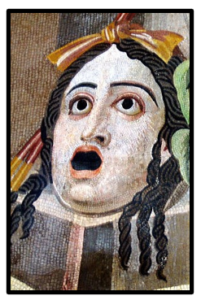
We would forgive the folks in a memory care unit for this mistake of standard usage. But it is unforgiveable at the Presidential level when the misuse is bound up with real lives that have been lost. It is the equivalent of calling a tyrannical leader a “depot,” or state-sanctioned executions as useful “detergents.”  These malapropisms can be funny when the speaker is in on the joke, which was usually the case with people in our recent past like George W. Bush Jr. and comedian Norm Crosby. But it is a grotesque reveal of stupidity when the user does not care about what is an unintended signifier.


two color line

Mangling the Language

[There is a part of me that loves to hear our ever-resourceful language mangled.  Every choice of the wrong word is a wonderful confirmation of how much we are able to lay down the tracks of expectations, only to be surprised by the misuse of a term. We usually know where the tracks should head. Here are a few malaprops and miscommunications that are still funny.]

Second Thoughts Banner

Some thoughts inevitably wander off course.  A person’s consciousness may have a clear fix on an idea, but the neural pathways that produce speech have to be able to deliver it.

A friend recently emailed a couple who had sold a property they owned in Florida after many attempts, noting that they must be glad to finally “be rid of their condom.”  I’m sure they eventually figured out what she meant. If all else fails, blame the autocorrect function on the computer. I similarly recall an errant explanation to students describing the risks to American troops stationed in Afghanistan and Iraq.  I noted that soldiers were constant targets for “exploding IUDs.”  It’s an example of a wrong turn on the highway to fluency that my colleagues won’t let me forget.

A malaprop is a near miss: the wrong word or phrase used in discourse that was striving for an idea that sounds similar.  When President Trump recently talked about the “oranges” of the Mueller investigation, we can figure out that he probably meant “origins.” It’s the same process that showed up in his press conference with the chairman of Apple, known to the rest of us as Tim Cook. The orange President repeatedly referred to him as “Tim Apple.”  Clearly, older minds are not as nimble as younger ones.

Malaprops were a source of a lot of American humor in the last century.  Performed routines featuring mangled English were often a staple of earlier radio and television comedy.  Think of Gracie Allen, Mel Blank or Norm Crosby. As Marjorie Gottlieb Wolfe recalls, audiences loved Crosby’s references to “human beans,” “trousers that need an altercation,” a sports idol who is “an insulation to young players,” and human bodies that can be “subject to so many melodies.”

Back then there was more laughing and less mocking. After all, like puns, malaprops that we notice require a degree of literacy; the fun is in recognizing the violated grammatical or lexical rules.

Mastering the burdens of language is a never-ending duty.

In recent years politicians have supplied all the miscues we need to keep us in grinning.  Without doubt, George W. Bush remains our single best source of a public figure whose thoughts have wandered into the wilderness.  He seemed to know what he wanted to say, but sometimes lacked the verbal skills to actually deliver it.  Here are some samples, courtesy NBC.

Of course the problem turns more serious when the speaker or writer is not aware that they have used the wrong words.  The joke is then on them, feeding the impression that they are perhaps not as swift as we might have thought.  Such is the power of literacy signifiers. Language usage is always work in process that is never fully done.

two color line


Revised square logo