We tend to not notice what we cannot name. Indeed, a lot of high-order thinking depends upon language. So there is truth in the counter-intuitive conclusion that language guides thought. Language is the great engine of consciousness.
Nothing is so disorienting and also exhilarating than introducing an idea that has the effect of turning the world as we think we know it upside down. And so it is with the Whorf-Sapir Hypothesis, a theory of language use and acquisition that proposes a very different relationship to experience than what we usually assume.
For most people, language is a tool for communicating experience. It is common to believe that words function as mostly inadequate snapshots of a far more vivid reality. We may hastily put the words together. But the reality is always there. Or so we think. But what if the reverse was true? What if language is in fact the primary window for perceiving, and not having a vocabulary for experience means that we don’t have the experience? That’s the essence of the hypothesis proposed years ago by two linguists working independently of each other. Among their studies, Benjamin Whorf and Edward Sapir noted, among many other things that in the Hopi Language of the Southwest some colors familiar to English speakers are not named and often not noticed. In addition, Hopi doesn’t usually specify past and future tenses, as many other languages do. Not having these “semantic domains” usually means not organizing our thoughts in these categories.
Since a lot of higher order cognition depends upon language, we don’t consciously focus on what we cannot name. Hence, we get to the startling and counter-intuitive conclusion that language guides thought. Language is the great engine of high-order consciousness. For example, English exists within a grammar of binaries. We think of something that “is” or “isn’t,” sometimes a far cry from more nuanced Asian languages that more easily accommodate the idea that something can be both at the same time.
At some levels this kind of linguistic relativity is obvious. Some languages make feminine and masculine references part of nearly every sentence. They are much more gendered. We also know that children usually acquire the impulse for racist actions often from the language of peers or parents, not their daily interactions with others. And more hopefully, we delight when a child acquires a name for an activity and expands her world into it. Indeed, we organize our educational system mostly around the idea of literacy. Reading and writing are justifiably considered the gateways to a richer cognitive life. There’s good reason to worry if Johnny doesn’t want to read, or isn’t acquiring the kind of extended vocabulary we expect through each stage of the graded school system.
A great deal of education even at advanced levels essentially continues the process of vocabulary expansion. This kind of linguistic determinism explains how we acquire the insights of an expert. Working as a lawyer is functionally the process of making use of the generative power of legal terminology.
Consider another example: Most of us at a party just see a room full of people. But a person who has just finished a course in Abnormal Psychology is probably going to notice more: perhaps the “bi-polar” behavior of the guy in the corner, the clinical “depression” evident in the young woman who went on at length about her family, and the “obvious paranoia” of the couple engaged in all kinds of survivalist activities. We tend to notice what we can name. “Depression,” “paranoia,” “bi-polar:” this partial lexicon of mental health diagnosis leads us into a world of ostensible maladies we would otherwise miss.
Even so, taking the theory as a core operating principle in communication is a hard sell to most Americans, who see language as a residue rather than a driver of experience. We routinely underestimate the verbal roots of most of our perceptions: constructions that only come to life because we have the right verbal equipment.
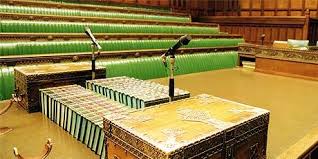
Dispatch Boxes (Lecterns) in the House of Commons Parliament.UK
What many in Britain consider a stale feature of their system would be nothing less than a breath of fresh air in ours.
The beginning of a presidential election season in the United States is now greeted by voters with an understandable amount of dread. To be sure, we want to celebrate the idea of elections. No one should be cynical about a system that insists on the consent of the governed. But it is hard to look at the truly awful media spectacle that has unfolded thus far and still be optimistic about our national political life.
Most Americans know that something is seriously amiss, even if it’s not clear how to redeem the campaign process to become what it currently is not: an opportunity for a great national awakening. We have “debates” that are really just joint press conferences, as well as seriously reduced coverage of any candidate that isn’t a poll leader. The reliable Tyndall Report notes that to this point Donald Trump has gotten nearly half the press coverage among all the Republicans seeking their party’s nomination. Moreover, we are saddled with prime-time stories from cable news outlets that constantly verge into “he said-she said” name-calling, as well as too many reporters spending most of their time interviewing other reporters. With the exception of a few serious news organizations, even larger news outlets seem to be averse to boring their audiences with substantive discussions of candidate responses to pressing national and international crises. It’s become so bad that what many in Britain consider to be a stale tradition within their system would be nothing less than a complete breath of fresh air for ours. We could really use something like Parliament’s weekly round of Prime Minister’s Questions (available for viewing at C-SPAN.org).
Every Wednesday Britain’s Prime Minister is obligated to appear in the House of Commons and face questions from leaders of other opposing parties, with the greatest number of queries coming from the leader of the largest faction out of power, and possibly the next Prime Minister. This is the system in most western parliamentary systems, working reasonably well in Australia, Canada and a number of other countries. What it allows is a lowering of the Constitution-mandated wall between the legislative and executive functions that exists in the United States. Reducing that wall makes possible the kind of discourse that is needed in times when leaders need to be on the hook to find solutions to serious national problems, such as our chronic lateness in passing a federal budget. Frequent and direct debate between the leader of the government and those in opposition has a way of reminding everyone of significant issues in dispute.
Prime ministers generally have a good idea of what they will be asked about. And those doing the asking are not above framing questions to score some easy points against the party that actually has to govern. But Question Time has two huge advantages over American divided government. One is that questions in the House of Commons are not filtered through journalists scrambling to get screen time while also trying to function as surrogates for the other side. All that exists between the “dispatch box” of the Prime Minister and the leader of the opposition is a distance of two sword lengths, a prudent design decision made long ago by British parliamentarians. The second is that name-calling and personal attacks won’t cut it in PMQs. It’s easier to call an opponent a liar to a reporter than to the opponent’s face. Direct debate without intermediaries means that questions will have to deal with affairs of state. Discussing anything less looks like evasion.
It’s a weakness in our system that nearly all of the political “debate” that occurs happens in the circus of campaigns, or sequentially through speeches by Presidents and congressional leaders given to their most ardent supports. Except for the yearly trek to Capitol Hill for the State of the Union Address, we simply have no mechanism for our national leaders to publicly argue the merits of their ideas in the presence of each other. The debates that do occur are usually private, when congressional members or their staffers meet with White House officials to iron out compromises. In the process, robust public discourse in the world’s greatest democracy withers. On most great issues the best we get is yet more sequential press conferences and the empty posturing that comes with them.
The problems hinted at here are myriad and complex. But its hard to not conclude that our governmental system is broken in part because it depends too much on the press–what optimists used to call the “fourth branch of government”–to report the excruciatingly tough issues that those who govern must address.