Many seem comfortable living without even an elementary understanding of the world they “know.”
In his sobering 1989 study, Democracy Without Citizens, Robert Entman dwells on the irony of living in an information-rich age among uninformed citizens. There is a rich paradox to a culture where most have a virtual library available on any digital device, and yet would struggle to pass a third grade civics test. According to the Annenberg Policy Center only one in three Americans can name our three branches of government. And only the same lone third could identify the party that controls each of the two houses of Congress. Fully a fifth of their sample thought that close decisions in the Supreme Court were sent to Congress to be settled.
Add in the dismal results of map literacy tests of high school and college students (“Where is Africa?,” “Identify your city on this map”), and we have just a few markers of a failed information society.
As Entman notes, “computer and communication technology has enhanced the ability to obtain and transmit information rapidly and accurately,” but “the public’s knowledge of facts or reality have actually deteriorated.” The result is “more political fantasy and myth transmitted by the very same news media.” We seem to live comfortably without even elementary understandings of the complex world we live in.
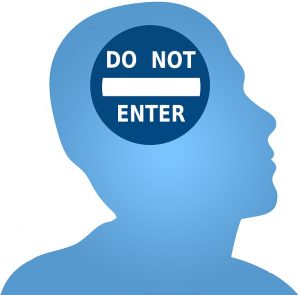
This condition is sometimes identified as a feature of the Dunning-Kruger effect, a peculiarly distressing form of functional ignorance observed by two Cornell psychologists. Many of us seem not to be bothered by what we don’t know, overestimating our knowledge. Dunning and Kruger found that “incompetent” individuals (those falling into the lowest quarter of knowledge on a subject) often failed to recognize their own lack of skill, failed to recognize the extent to which they were misinformed, and did not to accurately gauge the skills of others. If you have an Uncle Fred who is certain that the President is a Muslim who was born in Kenya, you have an idea of what kind of willful ignorance this represents.
Think of this pattern in an inverted sense: from the perspective of individuals who truly know what they are talking about. For even the well-informed, the more they know about a subject, the larger the circumference of the borderlands that delineate the unknown. That’s why those who have mastered a subject area are often the most humble about their expertise: their expanded understanding of a field gives them a sense of what they still don’t know.
The key factor here is our distraction by all forms of media—everything from texting to empty-headed television programming—that leaves us with little available time to be contributing members of the community. When the norm is checking our phones over 200 times a day, we have perhaps reached a tipping point where we have no time left to notice our own informational black holes.
With regard to the basics of membership in a society, the idea of citizenship should mean more. In this election cycle it’s worth remembering that nearly half of eligible voters will not bother to vote. And even more will have no interest in learning about the candidates who want to represent them in Congress or their local legislatures. Worst still, this is all happening at a time when candidates have been captured by a reality-show logic that substitutes melodrama for more sober discussions of how they intend to govern. Put It altogether and too many of us don’t notice that we are engrossed with the sideshow rather than the main event.
The boiler that should be white hot in youth can now seem too tepid, a long way from generating a significant head of steam.
Mental Health professionals often recognize a common symptom in patients characterized by an immobile face, little interest in the world around them, and a very narrow expressive range. This at the end of a scale that is far away from the idea of an animated and expressive individual. “Low affect” is sometimes a sign of depression. It can also be a side effect of certain medications. But I also wonder if it is becoming a comfortable norm for too many young Americans who have overdosed on the sedative effects of screens.
This thought came home a few weeks ago watching a college drama instructor working with her students in an acting class. A course in acting can be a wonderful experience even for students with no interest in a theatrical career. Taking on a role is a chance to try out the feelings and emotions of another character. It’s a way to step into alternate personas. Add in the fact that most plays keep a character’s pain or joy close to the surface, giving new and productive emotions a rare workout. I recommend the course to any student in any field of study.
In this particular class the instructor was working with one young woman who was doing a monologue in which a daughter explains to a friend a newly discovered cancer that may well claim her mother. Over the years the parent-daughter relationship has been stormy. The last line of the speech included a hint that it might be better if the mom succumbed sooner rather than later.
The segment from a Christopher Durang play suggested a long and complicated backstory that included the sometimes ambivalent feelings between mother and daughter. Tensions between the two have ebbed and flowed over the years. Yet the young actress could only motivate herself to “play” the reading in a gray apathy. Her lines were spoken in a monotone and with a face that gave nothing away. That was her understanding of the character’s state of mind, she noted, in spite of the teacher’s insistent plea that this character surely had other emotions—anger, disappointment, fear, regret—that needed to surface. The frustration of the instructor over the flat reading was obvious, similar to what Dustin Hoffman’s perfectionist actor felt in the iconic Tootsie (1982). Hoffman’s Michael Dorseytries to get his girlfriend and acting student played by Teri Garr to perform “rage” for an upcoming audition. That’s what her character needs to feel, but Garr’s is up to little more than a whimper. That is, until Dorsey finally coaches her to bring the anger out in the open.
Of course it’s risky to draw much from these simple examples. But they fit with growing evidence that too many young adults have been benumbed into a muted conversational style. “Performing” one’s enthusiasm for an idea or activity seems out of style. The boiler inside that should be white hot can seem too tepid to generate a sufficient head of steam.
Anyone who teaches the arts of advocacy beyond high school knows this challenge. We typically want students to issue full-throated spiels of passionate conviction in their debates or speeches. What faculty often hear instead is a shocking statistic or example delivered in a whisper, stripped of all anger or irony. The effect is similar to a musician who may have an instrument capable of many octaves, but chooses to use only the middle two.
We might extend a booming greeting to a friend we are surprised to meet on the street. But that kind of vocal and physical effort makes no sense if our thumbs are doing all the “talking.”
We have research from Sherry Turkle (Reclaiming Conversation, 2015) and others suggesting that conversation—at least the traditional form of face to face exchange–is not the defining moment to make an impression that it was for early generations. Younger Americans now “meet” on screens, keep in touch on screens, and deliver news in the staccato shorthand of texting. We see this as “connecting” and “talking” through “social” media. But staring into a screen for six hours a day requires us to mobilize almost nothing of the physical tools of expression. Face, voice and emotion do not easily reconfigure into words seen as pixels or heard in compressed digital channels. We might extend a booming greeting to a friend we are surprised to meet on the street. But that kind of vocal and physical effort makes no sense if our thumbs are doing all the “talking.”
Then, too, greater numbers of students are now showing up on the nation’s campuses with increasingly complicated mental health histories that might explain restrained expression. More now depend on the use of psychotropic drugs to treat anxiety, depression, eating disorders and ADHD. The effects of the relevant medications overprescribed for them can vary. But some can subdue what might otherwise be a buoyant personality.
In the 1960s sociologist David Riesman noted a broad cultural shift that changed the nation’s character: an alignment that re-oriented Americans from the “inner-direction” once common to individuals in an agrarian culture toward a more adaptive “other direction” required to succeed in industrial organizations (David Riesman, et, al, The Lonely Crowd, 1961). The other directed person had to be more social to survive. Our growing attention to personal media may signal a smaller but similar kind of characterological shift that leaves its own marker represented as a drift toward low affect. In the process the body becomes a more constricted medium than it once was; it’s owner less inclined to “perform” passions and interests with the kind of vocal animation that we might now judge to be nearly “manic.”
Interestingly, over a longer period of time the problem ceases to be an anomalous result. The subdued self just becomes a new norm that makes the natural enthusiasms of childhood stand out in contrast all the more.
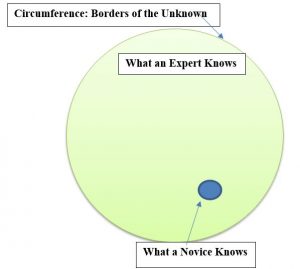 Think of this pattern in an inverted sense: from the perspective of individuals who truly know what they are talking about. For even the well-informed, the more they know about a subject, the larger the circumference of the borderlands that delineate the unknown. That’s why those who have mastered a subject area are often the most humble about their expertise: their expanded understanding of a field gives them a sense of what they still don’t know.