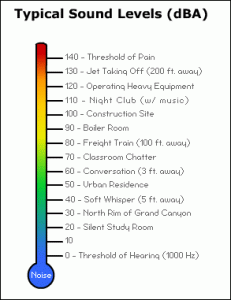
A reasonable noise level at a restaurant should be about 65 decibels. But many easily top 85. Little wonder noise is the most common complaint about eateries of all sorts.
These days when the New York Times restaurant critic Pete Wells writes reviews, it’s not uncommon to read about sound levels in expensive establishments that are “abusive” or “overpowering.” That’s not always the case. But high New York rents dictate small rooms with many tables. And the bar culture especially in after-work watering holes nearly duplicates the sound intensity of the beachside runway on St. Maarten’s. We have all had the experience of spending an evening with others where our time together was defined less by the food coming from the kitchen than our skill as lip-readers.
OSHA
The World Health Organization notes that the normal nighttime noise level for a large city should be no more than 40 decibels. (This measurement scale is logarithmic; every three decibel increase roughly doubles perceived sound intensity.) Continuous sound topping 55 decibels can leave a person at risk of cardiovascular disease. That’s a considerable distance from the 120 decibels that can produce permanent hearing loss: a real risk for musicians of all sorts.
A reasonable noise level for a busy restaurant should be about 65 decibels. But many restaurants easily top 85 in their bars and main dining areas, a fact aggravated by the tendency of well lubricated patrons to talk even louder. Maybe the hard stuff should come with a noise warning as well as a proof number. Little wonder noise is the single biggest complaint leveled against eateries of all sorts.
The problem is common enough to get a separate web page from the U.S. Department of Health and Human Services. Their recommendations:
Spare your kids the noise.
Eat at off times.
Request that music or the sound on televisions be turned down
Ask for a quieter corner away from loudspeakers or loud groups.
There is a curious fact about excessive noise. Many of us don’t notice it. We are used to moving through environments that push at the margins of comfort. Some of us are natural stoics, bearing the burden of too much noise until it is mentioned by others. This is one reason excessive sound volume is a contributor to stress. As ambient sound turns into a roar it stretches the natural elasticity of our patience. In the end, we feel drained and fatigued without exactly knowing why.
We have evidence that internet users are less interested in tracking the provenance of a story than consumers of straight print media.
It comes as no surprise to any thoughtful consumer that most media make money by attracting eyeballs for the ads they have strung around their content. In print media this is the role of display advertising. In conventional television the clusters of ads that interrupt program content have the same function. Even so, in the large scale public migration to internet sites many consumers of “new” media seem not to have noticed the close proximity of genuine news to the qualitatively different “sponsored content” nearby. Sometimes these “stories” at the end of a section feature an interesting picture, the promise of a shocking revelation, and always another new set of pages that will pull us in to see even more ads. These “news” items are sometimes labeled “Promoted Stories” or content “From Our Partners.”
On one particular day the popular website The Daily Beast had sponsored articles at the end of real journalistic pieces from a range of self-interested groups. One “article” entitled “Do This Every Time You Turn on Your PC” was really selling “Scanguard,” which is supposed to speed up balky computers. Another “article,” “How to Fix Your Fatigue” was click bait from a food supplement “doctor.” And an ancestry research service was embedded in a third “news story” entitled “What did People Eat in the 1800s?”
Sometimes this clutter of “advertorial” content has no appeal. But we may find it irresistible to take a time-wasting detour baited by headlines like “You won’t believe how the actors in ‘Gilmore Girls’ have changed.” At the risk of giving away my Calvinist/Methodist roots, all this spontaneous grazing pulls us away from more purposeful tasks. As if we needed it, a writing course at the University of Pennsylvania is actually called “Wasting Time on the Internet.”
As things go, advertising masquerading as news probably doesn’t qualify as a crime against humanity. And there can be little question that news sites of all sorts need the revenue stream of advertising that allowed print media to prosper for well over a century. But a problem remains: paid web content is now melded so seamlessly into the mix of stories offered on many sites that we may fail to notice that we have passed from the hands of editors and journalists into a strategic marketing world dominated by advertisers and copywriters.
In greater numbers Americans don’t consider the self-serving nature of much online content.
This doesn’t pose a serious problem to a savvy reader. But we have more evidence that internet users are less interested in tracking the provenance of a story than consumers of straight print media. In greater numbers Americans don’t consider the self-serving nature of online content, even when solid expertise and neutrality should weigh heavily on what we “know,” especially if we are researching subjects as consequential as health information. This lack of critical insight makes Americans a bit less intelligent, turning us into better consumers than citizens..
Add in another factor that makes the problem of accepting low-credibility sources even more unsettling. Traditionally our memory for content outlasts our memory for where it came from. This so-called “sleeper effect” means there is a time in our cognitive life when we are more likely to remember a stray fact or assertion than the source that it came from. You know the effect if you have ever heard yourself say “I don’t remember where I saw it, but I do remember seeing . . .” It’s at this point that the paid flacking of click bait creates the greatest opportunity for cognitive mischief. It’s content outlasts what should be reasonable suspicions about its fictions and limitations.