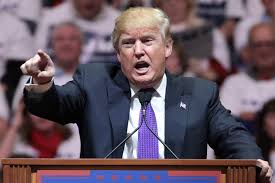
Trump ran as an insurgent. But he can’t govern as one. Our badly split nation will need a leader who can find principles of common ground even with political opponents.
There’s an old joke about a politician who is asked his favorite color. And, of course, it’s plaid: something for everyone. The conventional wisdom about political animals is that they will say anything to be liked, to fit in, to be connected somehow to their constituents.
We often denigrate this feature of political life: the urge to ingratiate oneself to others. But what if we elected a leader who got most of his rhetorical energy from rhetorical separation? How could he possibly lead a great and diverse nation? The short answers are that we have, and that he probably can’t.
The election of Donald Trump is a milestone in so many ways. We’re familiar with the “firsts” and near firsts:” a chief executive who will assume power with no experience in public office; the first winning candidate in the modern presidency to abandon close consultation with the agencies during the transition—including Defense and State; the only modern American presidential candidate who campaigned on the pledge to “lock up” his opponent; and the first leader to float toward inauguration day still attacking members of the press and movie stars. All of this is made worse by the fact that Trump seems to be addicted to a medium–Twitter–more appropriate to adolescents than the leader of the western world.
During the campaign Trump was a rhetorical flame thrower. Many thought that side of this impulsive man would diminish. But it has not and probably won’t. More than most, he is energized by his enemies. The very thought of them translates into angry withering criticism, and complaints that his critics are “dishonest” and “finished.”
What this all portends for the nation is not good. Trump ran as an insurgent. But he can’t govern as one. Our badly split nation will need a leader who can find the transcendent principles of common ground even with his political opponents. As Georgia State’s Mary Stuckey reminds us, presidents are not only commanders-in-chief, but also interpreters-in-chief. Their obligations in the rhetorical presidency include affirming the basic decency of Americans, invoking shared national values, and consoling the nation in times of national trauma.
Think of President Obama’s rhetoric of forbearance on health care reform and immigration reform. Think of his good humor in the face of birth certificate “truthers” like Trump, or the crude obstructionism of Senate Majority Leader Mitch McConnell and others. President Obama’s rhetorical nature was of a serious but positive agent for change. He shared that optimistic style with most of his predecessors, including George W. Bush, Bill Clinton and Ronald Reagan. We usually need to look to the Senate to find historical figures who thrived on indictment and division, figures like Joe McCarthy and Huey Long.
He seeks mostly his own counsel, turning himself into the equivalent of a sailor who uses astrology rather than astronomy for navigation.
It does not help that the President-elect seems to be incurious by nature. As MSNBC’s Rachel Maddow has pointed out, his utterances on events like the Navy drone capture by the Chinese have been embarrassingly behind actual events. He seeks mostly his own counsel, turning himself into the equivalent of a sailor who uses astrology rather than astronomy for navigation.
We can hope he changes. This nation is going to badly need a leader who can function as a broker and unifier.
___________________
A version of this essay first ran in the Star Ledger, January 1, 1017.
The body levels a kind of energy surcharge for focusing on the feelings and ideas of others.
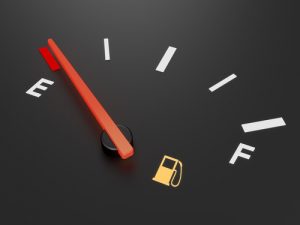
New cars come with instruments that let a driver know how well they are stretching a gallon of gasoline. Hit the accelerator for repeated jackrabbit starts and the car will let you know you could do better. Mine has a video display that sends a not-so-subtle message of leaves falling off branches.
We don’t have the same metrics to let us know when we draining our personal energy supplies. But we know. Spend an afternoon hiking, cutting wood, cleaning a house or listening to Uncle Fred’s conspiracy theories and we can immediately recognize the effects of physical or mental exhaustion.
The last instance is a special case. Straining to capture another’s words is tiring: perhaps less in terms of calories burned than in the mental fatigue that comes with processing and reacting.
For most of us, speaking appears to be the key communication challenge. Who doesn’t blanch at the thought of formally addressing a group? But accurate and thoughtful listening is often more demanding. The body levels an energy surcharge for being intensely engaged with the feelings and ideas of others. Following another’s rhetorical wanderings is more taxing than creating our own. Even though the body appears to be inactive, the mind may need to function like a turbocharger responding to an engorgement of air and fuel.
Some jobs are repetitious. We can perform them without becoming cognitively engaged. But talk to a psychotherapist, a judge, a court reporter, a good customer-relations specialist or a score of individuals in the “people” business, and most will report mental exhaustion at the end of the day. Hearing others well enough to successfully deal with their problems is an underrated skill. I’m certain the hardest work I do as a professor is–of all things–listening to formal student debates. In my course in Argumentation I need to hear and assess speeches, rebuttals, counterclaims, and cross-examination questions and answers. At the end of the debate my notes look like less organized version of a New York City subway map. Even so, I still miss a lot. Tuning out for even a few seconds allows ideas to escape unheard or underappreciated.
It helps to formally put the task on the day’s agenda of the hard work that lies ahead.
None of us are immune from the fatigue that comes with listening for meaning and nuance. What helps, however, is the creation of a conscious awareness that an impending listening task will be its own kind of tough work. For this reason it helps to acknowledge listening challenges to be faced before they start. Just as you might “psych” yourself help for a presentation to a group of people, it is helpful to mentally process the fact that the next minutes or hours will require some prodigious listening. This puts the task on the day’s agenda of the challenging work to be completed. Think of how often you pass on specific and important information to others who show no sign that they see the moment as significant. Note taking, or asking for clarification would be what most information-givers would like to see. What we usually get instead is an individual cognitively ‘idling’ while giving the appearance of being tuned in.
It would be nice to report that mental effort burns calories. But that’s not really the case. Mental exertion does seem to burn glucose, but that’s no pathway to weight control. And there’s the rub. The energy we expend in active listening produces mental fatigue, but not a physical “burn,” giving most of it’s benefits to the person who was given the gift of being heard accurately.