Many Americans worry when the defining features of one group are used for commercial purposes by another.
Identity politics defines our age and is scattered through the nation’s history. A nation spread across a continent is bound to be divided into regional and social allegiances, even though these social anchors often trigger thoughtless comments and lasting resentments.
We are all complicit. Thinking in terms of one’s own community first is a natural impulse. But inevitably sensitivities can be stepped on when ‘outsiders’ adopt or imitate another group’s practices and traditions. This is a familiar issue with the names of the Washington Redskins and the Cleveland Indians. Are these sports teams entitled to use native American symbols? Is the use of key words and symbols an inherent complement to the first Americans, or a commercial gambit the teams are not really entitled to? Legal entitlement is one thing. Cultural entitlement is less definitive, if no less involving. As with so many linguistic issues, applications of a group’s lexicon or symbols are almost always subject to different understandings. And in these days when nerve endings are more exposed, the appropriation of any group’s names and artifacts can raise eyebrows. In our climate of discontent, even viewing a mainstream Hollywood film from a previous decade can make us queasy. Why are there only African American actors in 50’s comedies playing maids or butlers? Why was the lead in the popular Charlie Chan series given to a Swedish American?
What may seem like acts of empathy or flattery to one person can be another’s example of expropriation.
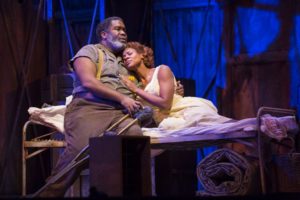
No short essay can do this subject justice. But the questions we might ask are still valuable. While Americans in the 21st Century are more open to claims of “cultural misappropriation,” we are still search for the outer limits of this kind of critique. Who gets to be an authority on Thai or Mexican food? Who gets to be a French chef? Likewise, did George Gershwin and DuBose Heyward step over the line to write the iconic black opera, Porgy and Bess? I’m glad they did. But was the story of the impoverished residents of Charleston’s Catfish Row theirs to tell? In its time (1935) Porgy was a daring extension of a tradition-bound form. But what may seem like acts of empathy or flattery to one person can be another’s example of expropriation.
We can all cite less cosmic examples of cultural infringement. When I was a visiting professor years ago I can remember my chagrin when otherwise wonderful British colleagues greeted me with an over-the-top “Howdy Partner!,” delivered in a theatrical Midwestern drawl. Minor stuff for sure; I suppose I could have responded with a fake Lancashire accent. But what would be the point? I would have preferred a greeting in their own voice.
The image of an American melting pot has begun to yield to the realities of a rising tribalism. This idea was behind Pete Wells’ concern in a recent New York Times review of a restaurant built on the side of an old recording studio. The decor featured lots of images of African American recording artists like Stevie Wonder, even though none of those performers apparently recorded at that 10th Avenue location. This made Wells “uncomfortable.” “Stevie Wonder will always be cool,” he noted, “but a restaurant dreamed up by real estate developers doesn’t automatically become cool by putting him on the wall.”1
Is there a legacy–a history, an origin–that is a community’s property, but not necessarily the culture’s?
This issue raises the question of what constitutes fair use of a group’s symbols. Does the existence of a common language within the culture extend to the words and images associated with a specific sub-group? Or is there a legacy–a history, an origin–that is a community’s property, but not necessarily the culture’s?
In a famous essay the journalist Walter Benjamin considered a related problem: the difference between original works of art and the sometimes convincing copies made of them. “The work of Art in the Age of its Technological Reproducibility” raised better questions than answers. But he did make the point that an original retains an “aura” that will always make it different and special, even while it may be cheapened by its copies. Our age has simply pushed the discussion forward to the moral question of whether those outside an exploited group have the right to use elements of the group’s legacy.
However one feels about a particular case, the viability of the idea of ‘offensive misappropriation’ is a clear indicator that bonds to specific communities may now be stronger than bonds to the culture. That’s surely one reason the idea of “tribalism” has become the word of the moment in discussions about current American attitudes.
Most of us are not very practiced in using a tool that have we’ve been given. We listen to others. We notice sounds. But we’re not very sophisticated in appreciating what pristine sound can reveal.
Imagine a relative who rarely strays from home and who has also just bought a luxury performance car. It will transport him to and from the grocery store, along with a few other places in his community. But the car will probably never see the open road. So it all seems like a mismatch. The owner will ask so little of a car that is designed to do so much.
The same can be said for how we use the miraculous sense organs thoughtfully attached to both sides of our head. We and most animals are binaural listeners. We hear in stereo. And that gives us the ability to locate where sounds come from. But that’s only the start. The mechanical bones and nerves of the middle and inner ear are amazingly sensitive. They are—pardon the pun—perfect windows fully open to mere whispers coming from the outside world. Admittedly, if you are my age, they are mostly open. Hearing acuity is best in children, which is one reason they are easily startled by the rude noises of the everyday life.
Here’s the point. Most of us are not very practiced in using the tool that have we’ve been given. We listen to others. We notice sounds. But we are too accepting of assaults on our ears in places where we work and play. These intrusions into our aural space may come from motorcycles, lawn equipment, loud restaurants, car horns and a hundred other sources. We tolerate loud noise and constant sound—frequently frying ears and brains in the process. A result is a dulling of our hearing, forcing us to miss what pristine sound can tell us.
All of this forces us to overlook the pleasures of natural sound layering, where ambient sounds can mix or contrast with dominant foreground source. For example, stand in a quiet forest long enough, and our aural sense of depth can open up. In the woods, air moving through trees has its own auditory signature. Add in a pair of birds calling back and forth to each other over a distance, and the whole scene seems richer and more interesting. This is dimensional listening, reclaimed when we liberate ourselves from the racket of a world.
The organized sound of music is where we are more likely to pay attention to the spatial capabilities of the aural. But even here, we frequently ruin the experience by depending on cheap electrical devices that distort, or are too loud for the delicate mechanisms of the ear. The result flattens music into a one-dimensional experience.
Putting ambient noise into the mix helps us hear the dimensionality that we have often trained ourselves to ignore.
Consider a variation on this problem. If you view nearly any Hollywood film produced after 1950, the sound of the actors singing will usually not match the space they are in. Most were recorded on a sound stage first, lip-syncing later on the set. So at the start of the landmark musical Oklahoma! Curly rides his horse across the open prairie gloriously singing Oh What a Beautiful Morning, but in the incongruous acoustics of a reverberant studio. The same is true with most action sequences, where dialogue is re-recorded later on. “On location” sound is difficult to capture. There is an old assumption that “pre” or “post” dubbing will not be noticed. But your ears can easily recognize the aural discontinuity of different spaces.
Try this simple experience. Listen to a good acoustic recording on good headphones. And see, if over time, you can place the layout of the players or singers. Are they all in the same acoustic? Who is in front and who is in back? Where is the piano on the ‘sound stage’? And what is the room contributing to the sound? Hearing dimensionality recovers what we have often trained ourselves to ignore.
Listen to the iconic recording of Chan Chan from the Buena Vista Social Club below. You can hear the musicians spread out in the space of an old Havana studio once owned by RCA. The recording, like some live concerts, is a feast of coherent aural information. To use the old cliche, it seems like we are with these musicians, some of whom remembered when Havana at night was a rival to Miami.
What may seem like acts of empathy or flattery to one person can be another’s example of expropriation.
Is there a legacy–a history, an origin–that is a community’s property, but not necessarily the culture’s?