Anyone can hang a version of da Vinci’s Mona Lisa in their home or view it online. But seeing the original fulfills the desire for a pilgrimage.
What does it mean for a painting or a musical piece to be endlessly replicated and copied? Is a good reproduction of the Mona Lisa still a Mona Lisa? Is a march by John Phillips Sousa captured on old Victor acoustic recordings that he hated still a Sousa march? And what does it say about our sensibilities that a lot of people on the rim of the Grand Canyon seem to be preoccupied with a digital device rather than the glorious and unmediated view?
Budding critics and art scholars are usually required to take a look at Walter Benjamin’s seminal 1935 piece, The Work of Art in the Age of Mechanical Reproduction. He addresses the question of how we should treat a copy of an original at a point in time when copies of everything are mostly what we know. Benjamin claims an original has an “aura” that a reproduction cannot match. And yet, as the recent BBC/Netflix series Fake or Fortune makes clear, it may require the precision of an electron microscope to tell the difference between a Renoir and a good fake. We see millions of paintings done in the style of French master. If we love the style, why not love them all, regardless of their pedigrees?
To say the least, our relationship with an original in its own place is peculiar and unstable. Anyone trying to actually see the Mona Lisa in Paris or Vincent van Gogh’s iconic Starry Night in New York is likely to experience the same kind of crowding that happens on a subway platform. The mob scenes in the galleries often block a clear view of a painting, mostly because of a forest of cameras held high to catch the moment. What brings these crowds out? Is the real thing that much better than a good print? Do the hordes expect some sort of transference-by-proximity?
It’s usually the case that a photo of a painting or a bootleg of a concert will be a degraded form of the original. But I suspect the expectation of seeing more in the original is usually not the point. A better explanation is fundamentally social: tied to being in the presence of a recognized icon, even when the actual experience is surely a long way from what the artist envisioned as an ideal viewing experience. Indeed, the fact that there are so many copies of a cultural artifact surely increases the impetus to find the original.
Being in the space of the original is what functions as a kind of secular pilgrimage.
My theory: as individuals, we occasionally need just one degree of separation rather than six. We need to be at the scene of what everyone else celebrates second hand. And we need to take home some evidence that we were there. Anyone can hang a version of the Mona Lisa in their home or view it online. But being in the space of the original is what functions as a kind of secular pilgrimage. Somehow our status as an occupant of the planet is formally affirmed. Our own Hajj can lay claim to the association factor that comes with being in the same place.
None of us are immune to this pull. Ask anyone what they have put on their personal ‘bucket list,’ and you are bound to hear about places that are crowded with people on their own pilgrimages. These might include throngs of tourists in Times Square, the daily homages paid to any number of pieces of art sitting in a city’s premier museum, or even a tour of the Warner Brothers back lot. We seek the aura that Benjamin suggests, even though the circumstances of our attendance usually end up sabotaging what is or was so sublime about the original.
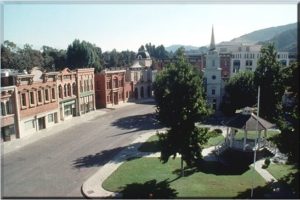
Midwest Street, the Warner Brothers Back Lot
For example, in Burbank we can still visit outdoor sets used in the shows The Music Man, Gilmore Girls and La La Land. But with film, the fakes are actually the sets, which are used along with a number of photographic “cheats” to make them look authentic. With film, the real thing is what actually ends up on a screen out in Duluth or Denver.
Of course being ‘in the scene’ says little about understanding what makes a work a masterpiece. For that we need the practiced eye of a dedicated appreciator, and maybe a sense of the consciousness an artist originally experienced. All may be more easily captured away from the crowds and planted in front of a good facsimile. But of course this deprives us of the social act of visiting our own version of Mecca.
The capacity to take endless numbers of pictures has outstripped most useful reasons for sharing them.
When I was still a student, I spent part of one fall working for a candidate running for the Senate from Pennsylvania. If our team was not yet known as one of the gangs that couldn’t shoot straight, we’d soon make a claim for the title. One event we planned was a simple ‘walkabout’ in downtown Pittsburgh. It’s a conventional campaign move to notify the press and promise them pictures of your guy mixing it up with voters. But there was a problem with this particular event because we planned it for a Sunday. That was mistake number one, since the Golden Triangle on weekends was then a ghost town. Office workers were clearly restored to the suburbs by the end of the of the workweek on Friday. Pittsburgh was not quite the active American city that it is now.
Nonetheless, we did find some people for the candidate to meet. And without a second thought we moved in to introduce him, even though the few persons around were surprisingly reticent to be photographed. We had obviously missed the source of their reluctance, which was directly above our heads in the form of a theater marquee. Mistake number two: we were standing in front of a porn theater. Clearly a photo of the candidate under neon ablaze with a lot of X’s was not a winning political move. But give these folks staggering out of the theater some credit; they seemed to be as faithful in their Sunday morning attendance as the Presbyterians pouring out of their church down the street.
For this and many other reasons our guy lost, and I returned to the easier world of teaching and writing about politics.
His vacation-by-proxy has triggered your downward slide toward semi-consciousness.
The phrase “photo op” may have been a common idea then. But that usage is now too narrow. Today many of us are in the business of looking for visual opportunities to capture on our phones. That’s bad enough for the rest of us that have to look them, but made even worse by the fact that there is no longer a financial penalty for being a kind of serial shooter. There is almost no cost associated with producing images on digital media.
So now some of our encounters with friends are. . . how can I put this? . . photographically impaired. Instead of a routine conversation, there is too often a moment when the friend reaches into a pocket to pull out a phone. The heart sinks as he thumbs his way to a photo library that is revealed to be indecently large. How bad can it be? Perhaps we should be thankful he hasn’t downloaded all of Gone With the Wind. More likely, the scrolling images remind him of other recent high points he is only too happy to find on his small screen. Who wouldn’t want to share the joy of a hummingbird at 40 yards? You feign interest. But he has a lot of pictures. And if he’s been traveling, he will probably show signs of anticipation at the opportunity to relive his entire vacation. The extended narrative that can come with even the most homely shot can roll out like a kite string. And as all of this happens, his sidewalk reverie is becoming your nightmare. His vacation-by-proxy has triggered your downward slide toward semi-consciousness.
In the analog era it was the case that a long-lost friend might have had a few pictures in their wallet or purse. If they had kids, they were expected to trot out one per child, even though you could predict that the youngest would always look like Winston Churchill. You dutifully professed awe at their perfect beauty, and it was quickly over. The few pictures went back in the wallet and a conversation could then continue.
But now many of us think of ourselves as Ansel Adams. The capacity to take pictures has outstripped any functional reasons to share large quantities of them. A “conversation” built around one’s own snapshots is actually a monologue. And it’s another reason to consider disarming visitors right at the front door. There has to be a nice way to say that there will be no photo ops during their visit. Allow them in, but be sure their miserable tiny screens have been stored out of reach.



 The capacity to take endless numbers of pictures has outstripped most useful reasons for sharing them.