red concave bar 1

0 to 60 in Under 29 Minutes Flat

Getting up to speed is easy; it’s the sudden deceleration that poses all the problems.
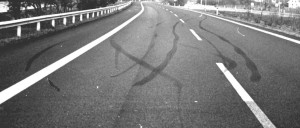
With what seems like the newspaper version of a straight face, The New York Times recently reported that a whole group of new electric cars available to the general public will be able to go from 0 to 60 miles per hour in “under 6 seconds.”

This kind of lightning speed is a standard metric in almost auto reporting. But why should we need to know?  We’d be better advised to consider whether the brakes in these cars might work to control the inevitable fish-tailing of drag-race speeds.

Five or six seconds is about the amount of time I need to even think about moving.  Short of a possible once-in-a-lifetime close call, is there any reason a motorist would want to put that metric to the test?  Perhaps in front of your house? Maybe near a school?  How about the parking lot at the supermarket? It may be different for you, but we have critters  and walkers in our neighborhood who are used to having more time to get out of the way.

The argument that freeway on ramps require G-force acceleration is often bogus. Most are designed to be long enough to allow drivers time to adjust and safely fit into the flow of traffic.  On an interstate near my house some merge lanes are a good half-mile long.

Auto writers seem to exist on another plane, where useful statistics are too routine to bother with. Useless statistics are another matter entirely.  This kind of breathless reporting is so common we hardly notice. Truth is, this kind of acceleration trivia is part of a much bigger pattern of mostly male-centered references to tired tropes of masculinity.  Muscle-car culture is getting to be pretty old-school. We should really know how efficient a car is in city traffic, where average speeds on weekdays barely reach into the thirties.

For the record, I could probably go from 0 to 60 in a few seconds.  But it would require stepping off a cliff. Getting up to speed is easy; it’s the instant deceleration that poses all the problems. That’s true of cars as well, as an any number of drag-race videos demonstrate. Surely everybody loves a responsive vehicle.  But how many have an interest in trying to turn theirs into a rocket?  (OK, how many over 40?)

I noticed that the usual guy reporting on cars for the Times seems to be gone. He did lots of videos of new models cruising sanely around his West coast neighborhood, gently corning at speeds you and I would recognize as sensible. I hope he wasn’t replaced because he was too practical.

To get real about climate change means thinking differently, and moving beyond amazement at the remarkable start-up torque of electric motors. This feature is impressive, and electrics will surely send internal combustion engines and transmissions to museums. But, all things considered, it seems useless to continue to enshrine jackrabbit starts in the rhetoric of auto reporting.

By the way, I think I could get my wheelbarrow up to 60 mph in less than 30 minutes.  But I would need the help of more wheels, and maybe Lombard Street in San Francisco.  But that would be bizarre, and completely meaningless.

Long bar

Giving Our Ears Their Due

Having spent the better part of the last two years writing about hearing and our sense of sound, here are a few takeaways about how we hear that may come as a surprise.

A key premise of The Sonic Imperative to be published in a few weeks is that sound is our newest sense. The widespread use of radio in the 1920s and magnetic tape recording a little later means that our modern comprehension of sound is only about 100 years old. Radio and recording made listening a prime preoccupation. Records added an additional level by making this, the most ephemeral of sense data, something that could be packaged and sold. Though streaming is the preferred way to access music today, for many of us it still matters to hold a copy of a performance in the form of a vinyl record or CD.

Here’s a few random but surprising facts about how we process sound.

  • People often say that they are “visual learners” or thinkers. We do learn from what we see. But sight is predicated on light, and we are not natural light emitters. But we were born to emit and receive sounds. It’s good to keep that in mind when we reflexively think of sight as the dominant sense. We surely need the advantages of seeing, but our basic social nature is predicated on hearing and learning spoken language.
  • Sound is created almost as much by the space it is in as by the source. Open spaces and rooms are major shapers of auditory content, with important effects. Even an expensive stereo system is going to sound crummy in a small room, or one with hard surfaces. In fact, a rooms designed to have no acoustic impact known as anechoic chambers would slowly drive most of us crazy in just a few hours.
  • A lot of music listeners have trained themselves to settle for inauthentic bass sound. They probably have listened for too long to bad audio that tends to create “one note bass.” This form of low frequency sound is a wad of noise that may be just “good enough” for a boom box or dance track. You can actually hear true bass when you can detect a distinct pitch and it’s overtones produced by a bass guitar, piano, or an organ pedal note. A low frequency bass note of 40 Hz, for example, is 28 feet long. A room shorter than that will force all of that high-energy sound to distort into indistinct one-note bass.
  • One way convenience stores disperse teens who want to hang out nearby is to employ a “Mosquito,” a proprietary “sonic canon” that emits a high-pitched sound that can only be heard by young ears. Some owners have also had success with baroque music.
  • Most Americans are careless in protecting their hearing. It is useful to remember that sound is created by zephyrs of moving air that can often only sensed by our ears. It is incredibly easy to overwhelm the tissue and tiny bones that receive those feint sound waves and send them to the nerves of the inner ear. You are probably ruining you hearing if you listen to music with tight earbuds, cutting the grass without ear protection, or using earplugs at a pop music concert. Results unfortunately include many musicians and subway workers who eventually end up legally deaf.
  • There are 1400 loudspeakers in Citizens Bank Park in Philadelphia, mostly because baseball requires a big audio assist to keep it exciting.
  • Listening is the one sense that never rests. Indeed, we are even listening to our mothers in the womb, starting in the third trimester at about 30 weeks.

Paperback, 335 Pages
Order  at Amazon.com