Category Archives: Problem Practices

Communication behavior or analysis that is often counter-productive

Debased Debates

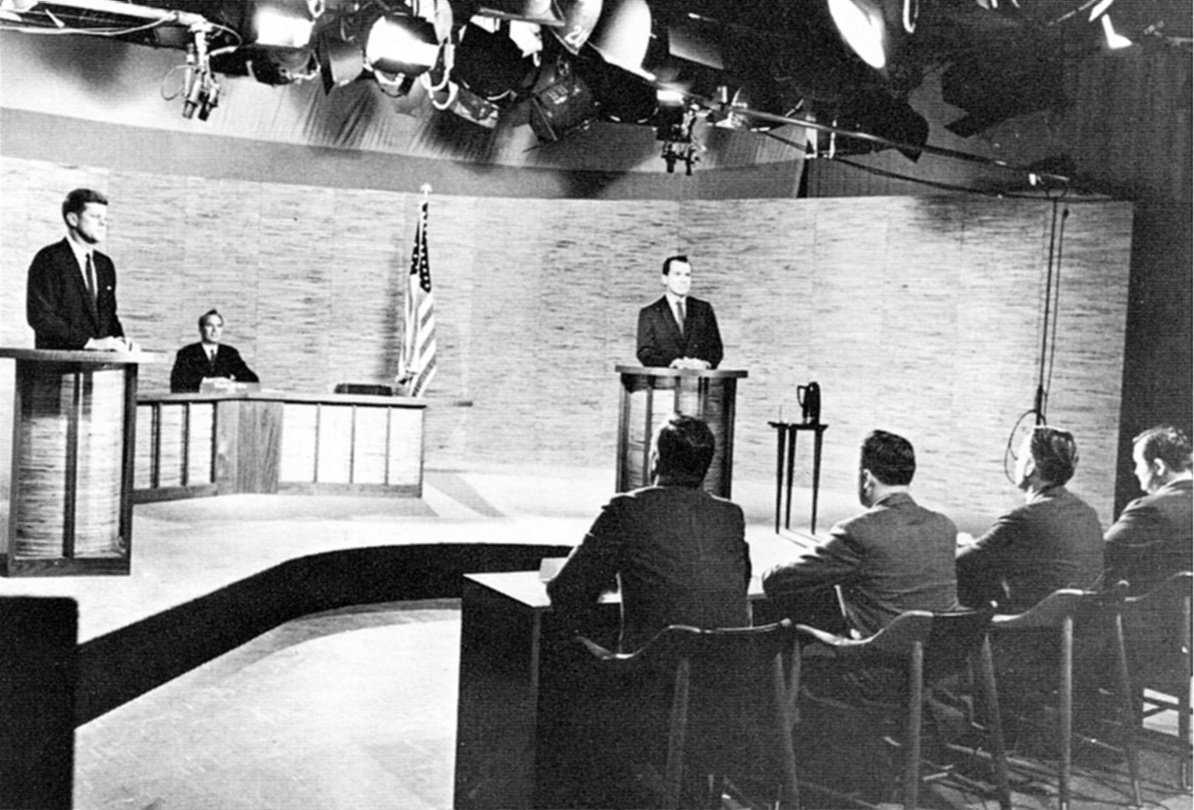
The Kennedy-Nixon Debates, 1960 Source: Wikipedia.org
The 1960 Kennedy-Nixon Debates                          Wikipedia.org

There is a wide perception that it is the moderator’s job is to comment on lies, half truths or false claims.  But that’s the job of the other debater. In a good debate the participants aren’t answering reporter’s questions, but fact-checking each other.  

The political season always brings out a cycle of “debates” finally agreed to by cautious candidates, news organizations, and good government groups. Though everyone involved has different motives, the one most commonly expressed is that debates offer the public the chance to compare candidates side by side. In the unfettered give-and-take of a debate we are supposed to learn about issues that divide and sometimes unify those running for the same office.

And yet most of these joint appearances are a sham. As usually formatted, they can’t achieve the lofty goals they allege.

A public debate done correctly should deliver what philosophers call “dialectic:” a purposeful clash of views where claims and evidence are tested against a series of counter-arguments.  Among others, Aristotle was certain that acts of public advocacy had a cleansing effect on the body politic. He believed we are wiser for subjecting our ideas to the scrutiny of others. This may sound lofty and abstract, but most of us do a form of this when we talk through a pending and important decision. We often want friends to help us see potential problems to our proposed course of action.

In open societies such as ours we expect to hear the contrasting opinions. It’s a wonderful process when it can be properly formatted. Otherwise—and as devised by most political operatives—a political debate is usually is little more than a joint press conference.

The problem is that candidates usually fear these exchanges. They and their staffs believe that a serious gaff can sink an entire campaign. So they hedge their bets. They agree to “debates” if they are moderated by a panel or at least a single journalist. This is when the process begins to go south. It’s further doomed when each side is given only a minute or two to respond the statements of opposing candidates. These errors are then compounded with a final counter-response that is barely the length of a sneeze. As it now exists, it’s little more than a lukewarm form of political theater.

I especially regret that the national Commission on Presidential Debates that includes some of my professional colleagues hasn’t significantly altered this ersatz format. A true debate will have no more than a moderator or time-keeper to equalize participation and keep things civil. In true debates there are no outside questioners. The advocates directly address the claims and arguments of their opposites on what is usually a single broad but important subject area. Their opening remarks must be permitted to be longer than a television commercial. They listen, refute, question, and challenge each other. When one issue seems to have been exhausted, the moderator may steer the pair to a related issue and then get out of the way.

Lincoln and Douglas debated for hours by themselves without the assistance of others. Indeed, a prime form of Saturday night entertainment in the 19th Century was a formal debate in a town’s biggest venue. The whole process of seeing two leaders explain their ideas under the scrutiny of an interested audience could be invigorating. By contrast, the short question-based formats commonly in American political debates generally ruin the chance to see how much a candidate truly knows beyond the memorized sound bites that they repeat at every stop. Just when follow-up rebuttals might begin to test a candidate’s knowledge of an issue, the questioners usually interrupt and move on to a new topic.

Last year Americans could catch a series of BBC debates in the United Kingdom between Alistair Darling and Alex Salmond on Scotland’s referendum to go it alone as an independent state. These weren’t perfect by any means. But these televised clashes had the advantage of allowing both sides sufficient time to make essential arguments and extended refutations. As can be seen during weekly Prime Minister’s Questions in the House of Commons (available on C-SPAN’s website), the British expect that their leaders should be able to stand up under sometimes withering criticism from their ideological opponents.

Our system conspires to do the reverse by giving unnecessary screen time to outside questioners, thereby protecting candidates by allowing them to stay in a comfort zone of stump-speech clichés and bumper sticker retorts.  Debates should expose the relevant facts and hard truths behind a decision to support or oppose an action.  We never let the candidates go on long enough to see if they have confronted those truths.

cropped-Perfect-Response-logo.jpg

Looking for Multiple Narratives


                      Wikimedia.org
    Five Witnesses Will Usually Have           Divergent Accounts of the Same Event                          Wikimedia.org


We should be impatient if the reporting from a given medium asks us to settle for just one “story.” The better option is to expect that there are at least several.

As people in my line of work are fond of saying, ‘language sometimes does our thinking for us.’  Word choices are tracks that inevitably point us in specific directions.   So when we talk about “media”—because it is a plural term—we are primed  to acknowledge significant differences between individual outlets.  That’s as it should be, and a way of thinking we need remember when we are acting on the basis of any single version of events.

For most of us, the concept of a “story” could not be clearer, setting up an expectation that we will take in a running version of events that can stand on its own. This is all well and good if we are talking about one individual’s experiences.  We are all entitled to our stories. They function to make life understandable and meaningful. They are also useful barometers of our own mental states.

Narrative fiction and films have our attention because they fulfill what we seem hardwired to need: figures to empathize with, and the continuity and simplicity of a single of perspective. This is the rhetorical form of the synecdoche: when one example stands in for a whole class of people or events.

The mistake is when we accept the adequacy of  singular form as a tool for understanding the real world. The cable-news anchorperson asks a reporter in the field, “What’s the story?” A headline launches a short version of events usually defined by its internal coherence.  An editor or producer presses a reporter to find a single experience that encapsulates a larger trend. As news consumers we are attracted to narrative continuity over reports that ask us to consider “competing realities.”  Complexity tends to get written out of accounts that need to be boiled down to one and half minutes of air time or 600 words of reporting.

But in actual fact, human events usually contain multiple and contradictory stories: accounts that  are often diverse in their details and frequently inconsistent with each other. We easily recognize this when we compare notes with family or friends about key events that we’ve shared about some earlier experiences of our ancestors. We expect to add details another missed, or to add alternative interpretations of a participant’s motives, or  to pass on an observation that is completely new to others. In those settings we are not surprised to learn that one version of events is not enough.  Eventually all the pieces put together form a kind of intersubjective truth that works at least for those who participated.

The same is true in the current news environment. The ongoing conflict between the state of Israel and Palestinians living on its borders does not permit the luxury of one narrative, but many. The controversial implementation of the Affordable Care Act cannot be contained in one  personal experience.  We know there must have many, reflecting the range of responses by individuals and the states where they reside.  Even when we think we have some clarity on the “aggression” of the Russian Federation in reclaiming Crimea and Eastern Ukraine, we can easily be surprised by long-form accounts from the region that can force us out of what seems  like a settled narrative.

We are smarter if we expect that news reports and other kinds of nonfiction accounts should come to us in uneven waves. In terms of conventional communication analysis, we usually look for a “preferred narrative:” the kind of account that comes from official sources and takes hold of the popular imagination.  But we also expect to find that there are “alternate” or “counter-narratives” as well, and often a series of them. These may come from the less powerful or the marginalized who were caught up in the same event.  It’s not unusual that years later they emerge as the new preferred narratives.

Charles Dickens started a novel with the famous lines, “It was the best of times.  It was the worst of times.”  The thought reflects his savvy as a narrator of the human condition.  We need to expect that there may be a plurality of perspectives that will undermine the coherence and psychological comfort that comes with a single account. “Reality” is often best represented in a Venn diagram of overlapping accounts. We need to remind ourselves to be impatient if reporting about human events seeks an unearned consensus by insisting on a single truth.

Comment at woodward@tcnj.edu