We have evidence that internet users are less interested in tracking the provenance of a story than consumers of straight print media.
It comes as no surprise to any thoughtful consumer that most media make money by attracting eyeballs for the ads they have strung around their content. In print media this is the role of display advertising. In conventional television the clusters of ads that interrupt program content have the same function. Even so, in the large scale public migration to internet sites many consumers of “new” media seem not to have noticed the close proximity of genuine news to the qualitatively different “sponsored content” nearby. Sometimes these “stories” at the end of a section feature an interesting picture, the promise of a shocking revelation, and always another new set of pages that will pull us in to see even more ads. These “news” items are sometimes labeled “Promoted Stories” or content “From Our Partners.”
On one particular day the popular website The Daily Beast had sponsored articles at the end of real journalistic pieces from a range of self-interested groups. One “article” entitled “Do This Every Time You Turn on Your PC” was really selling “Scanguard,” which is supposed to speed up balky computers. Another “article,” “How to Fix Your Fatigue” was click bait from a food supplement “doctor.” And an ancestry research service was embedded in a third “news story” entitled “What did People Eat in the 1800s?”
Sometimes this clutter of “advertorial” content has no appeal. But we may find it irresistible to take a time-wasting detour baited by headlines like “You won’t believe how the actors in ‘Gilmore Girls’ have changed.” At the risk of giving away my Calvinist/Methodist roots, all this spontaneous grazing pulls us away from more purposeful tasks. As if we needed it, a writing course at the University of Pennsylvania is actually called “Wasting Time on the Internet.”
As things go, advertising masquerading as news probably doesn’t qualify as a crime against humanity. And there can be little question that news sites of all sorts need the revenue stream of advertising that allowed print media to prosper for well over a century. But a problem remains: paid web content is now melded so seamlessly into the mix of stories offered on many sites that we may fail to notice that we have passed from the hands of editors and journalists into a strategic marketing world dominated by advertisers and copywriters.
In greater numbers Americans don’t consider the self-serving nature of much online content.
This doesn’t pose a serious problem to a savvy reader. But we have more evidence that internet users are less interested in tracking the provenance of a story than consumers of straight print media. In greater numbers Americans don’t consider the self-serving nature of online content, even when solid expertise and neutrality should weigh heavily on what we “know,” especially if we are researching subjects as consequential as health information. This lack of critical insight makes Americans a bit less intelligent, turning us into better consumers than citizens..
Add in another factor that makes the problem of accepting low-credibility sources even more unsettling. Traditionally our memory for content outlasts our memory for where it came from. This so-called “sleeper effect” means there is a time in our cognitive life when we are more likely to remember a stray fact or assertion than the source that it came from. You know the effect if you have ever heard yourself say “I don’t remember where I saw it, but I do remember seeing . . .” It’s at this point that the paid flacking of click bait creates the greatest opportunity for cognitive mischief. It’s content outlasts what should be reasonable suspicions about its fictions and limitations.
Many seem comfortable living without even an elementary understanding of the world they “know.”
In his sobering 1989 study, Democracy Without Citizens, Robert Entman dwells on the irony of living in an information-rich age among uninformed citizens. There is a rich paradox to a culture where most have a virtual library available on any digital device, and yet would struggle to pass a third grade civics test. According to the Annenberg Policy Center only one in three Americans can name our three branches of government. And only the same lone third could identify the party that controls each of the two houses of Congress. Fully a fifth of their sample thought that close decisions in the Supreme Court were sent to Congress to be settled.
Add in the dismal results of map literacy tests of high school and college students (“Where is Africa?,” “Identify your city on this map”), and we have just a few markers of a failed information society.
As Entman notes, “computer and communication technology has enhanced the ability to obtain and transmit information rapidly and accurately,” but “the public’s knowledge of facts or reality have actually deteriorated.” The result is “more political fantasy and myth transmitted by the very same news media.” We seem to live comfortably without even elementary understandings of the complex world we live in.
This condition is sometimes identified as a feature of the Dunning-Kruger effect, a peculiarly distressing form of functional ignorance observed by two Cornell psychologists. Many of us seem not to be bothered by what we don’t know, overestimating our knowledge. Dunning and Kruger found that “incompetent” individuals (those falling into the lowest quarter of knowledge on a subject) often failed to recognize their own lack of skill, failed to recognize the extent to which they were misinformed, and did not to accurately gauge the skills of others. If you have an Uncle Fred who is certain that the President is a Muslim who was born in Kenya, you have an idea of what kind of willful ignorance this represents.
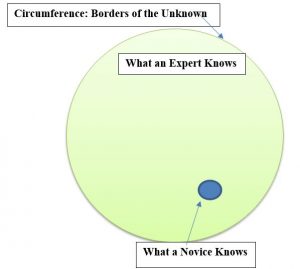
Think of this pattern in an inverted sense: from the perspective of individuals who truly know what they are talking about. For even the well-informed, the more they know about a subject, the larger the circumference of the borderlands that delineate the unknown. That’s why those who have mastered a subject area are often the most humble about their expertise: their expanded understanding of a field gives them a sense of what they still don’t know.
The key factor here is our distraction by all forms of media—everything from texting to empty-headed television programming—that leaves us with little available time to be contributing members of the community. When the norm is checking our phones over 200 times a day, we have perhaps reached a tipping point where we have no time left to notice our own informational black holes.
With regard to the basics of membership in a society, the idea of citizenship should mean more. In this election cycle it’s worth remembering that nearly half of eligible voters will not bother to vote. And even more will have no interest in learning about the candidates who want to represent them in Congress or their local legislatures. Worst still, this is all happening at a time when candidates have been captured by a reality-show logic that substitutes melodrama for more sober discussions of how they intend to govern. Put It altogether and too many of us don’t notice that we are engrossed with the sideshow rather than the main event.