There is the old joke about the New Yorker writer Dorothy Parker, who often turned to drink to quiet her own inner demons. “Bartender: What are you having? Parker: Not much fun.”
In these times many of us may feel the same way. It is a challenge to escape the chatter of negative thoughts. But heavy lubrication is probably not the answer, even though the sale of alcohol is up nationally.
A Google search using the three words that title this piece yielded 1,670,000 results. And using just the last two words increased the hits nine-fold. There is obviously an interest to explore our own recurring streams of “self-talk” and their more compulsive forms that psychologists label “rumination.” All the more, given these stressful times when unvoiced thoughts and worries may follow us through the day.
In a basic sense, self-talk is simply thinking. An active consciousness is partly what makes us human. As Jonathan Smallwood and Jessica Andrews-Hanna note:
Although mind-wandering may be unpleasant for the individual who experiences it and disruptive to the tasks of the moment, self-generated thought allows consciousness freedom from the here and now and so reflects a key evolutionary adaptation for the mind.
Indeed, consciousness is the gift that allows us to have an active interior life. We implicitly recognize this power when we refer to the active minds in ourselves and others: the vast but partly unknowable store of accumulated experience and personal insights that we all carry around with us but do not necessarily voice.
And yet it is common to hear stories about how disabling a person’s interior thoughts can be. The culture’s justifiable interest in stressed individuals now often comes with the caution that we can dwell too much on challenging circumstances. Solutions include seeking more exercise, turning off the news, or connecting anew with a friend or relative.
But it is useful to remember that our preoccupation with brain chatter is not a new concern. Novelist Tim Parks has argued that we have long had a crippling obsession with the literary device of the interior monologue. It’s been used by many of the twentieth century’s writers. Virginia Woolf’s Mrs. Dalloway is a representative case. Others such as Christopher Lasch have made the same point more broadly, seeing an inward turn in the American character. In the same century, he argues, our focus on our own needs made us a more narcissistic and self-obsessed nation.
And there is also our cultural romance with figures who seem to go against the grain and set their compass on their own passions, often at the cost of barely letting others into their lives. Socially challenged innovators—perhaps Thomas Edison or Steve Jobs—are often admired for showing a kind of single-minded preoccupation that plays out in desultory conversations with family and friends, but intense conversations within themselves. Scientific American’s Farris Jabr isn’t so sure, at least with regard to a fixation on interiority in modern popular fiction. He also challenges the idea that there is a culture-wide weakness for stories built around unexpressed thought. “Yes, we talk to ourselves—our minds chatter incessantly—and we are the saner for it.”
We just have to find creative ways to keep the demons at bay, at least for a little while longer.
An only child who had to oversee the passage of his parents, Christopher Buckley wrote about this lonely role with grace.
Many of us who struggle with the task of finding ways to give heat to ideas can usually point to favorites: cases where a writer has put the perfect image together to make his or her point. These passages are moments of rhetorical grace, sometimes represented by economy of style or an evocative image. Writers read partly to experience these moments. They add more fuel for the long slog of putting words on the page.
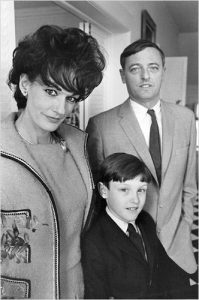
Christopher Buckley with his Parents
One personal favorite is from an unlikely source and subject. Christopher Buckley’s 2009 memoir of the last year of his celebrity parents is funny and wise on the demands of coping with the inevitable. In Losing Mum and Pup we see the conservative gadfly William F. Buckley Jr. and his socialite wife struggle to the end. An only child who had to oversee their passage through what his father often described as “this vale of tears,” Christopher also bore the role of keeper of the flame of their outsized legacies.
That the book could be characterized as a pleasure to read is a credit to his dry wit and effective storytelling. Humor and melancholy merge seamlessly. Among other things, his dad’s ability to cope with the death of his mother produces the kinds of serio-comic episodes that any caregiver with a sense of humor would recognize.
This is not just a memoir about wheelchairs and vacant faces. The younger Buckley has the good sense to understand the end of his parents lives mostly in terms of the consequential work done in their most productive years: Pat, in the upper stratosphere of New York museums and philanthropies, Bill in publishing and conservative politics. The senior Buckley had some awful views, but he was also a polymath with a wide collection of interests and talents.
Here’s a favorite passage seemingly about his father’s love of sailing, but also much more. It contains a wonderful image.
Pup was an avid sailor. He had learned to sail as a child in upstate Connecticut, on a not very large lake. Now we live on the Connecticut shore of Long Island Sound and kept a thirty-eight-foot wooden sloop. It was named Panic, a name my mother found all too apt. . . I now get that Pup’s greatness was of a piece with the way he conducted himself at sea. Great men always have too much canvas up. Great men take great risks. It’s the timorous soul—souls like myself—who err on the side of caution; who take in sail when they see a storm approaching and look for a snug harbor. Not my old man. Or as Mum used to put it, “Bill why are you trying to kill us?”Great men are also impatient. This particular aspect showed up most vividly in my father’s manner of docking his boats. Most people, when guiding, say a ten or twenty ton vessel toward a dock, approach slowly. Not my old man. His technique was to go straight at it, full speed. Why waste time? This made for memorable episodes.1
“Great men have too much canvas up.” It’s an apt image that seems completely faithful to the person who published the National Review. It was the perfect verbal image. Anyone who had observed Buckley on his Firing Line broadcasts or his work as a conservative essayist could also see the literal extended to the behavioral. Fearless sailing was typical of who the father was, even when he was heading in the wrong direction.
________________
1 Christopher Buckley, Losing Mum and Pup, Emblem Books, 2010., pp. 121-22.





 An only child who had to oversee the passage of his parents, Christopher Buckley wrote about this lonely role with grace.