This is a precious piece of jazz history, all the more so for being recorded in pre-corporate Las Vegas, which was fertile ground that helped good musicians become great.
Sometimes the perfect response is not what is said, but what is sung. Music is the great analogue to speech. And it seems that we often experience pleasure in a perfect match-up of words and music set alight by especially gifted musicians.
I always think of Nick Hornby’s feral but passionate clerks in High Fidelity. They shake off their mid-morning torpor when challenged by the owner to name the” top five” of any genre: autobiographies of musicians, blues recordings, songs about death, angry songs about women, songs to take on a desert island. In the novel and the even better film Barry and Dick may appear to be adrift and underemployed. But they are also connoisseurs, reminding us that we are all critics, and that ecstasy can even come in the transient moments of a musical phrase.
I’ve come to think of a particular song in this way. The music comes from a live recording made in 1966 and recognized by Rolling Stone, among others, as one of the best live recordings ever made. Track 18 is an especially precious slice of jazz history, all the more so for being recorded in pre-corporate Las Vegas, which was fertile ground that helped good musicians become great. The album is Sinatra at the Sands, made at time when the former “kid” from Hoboken was feeling the heat of the British pop invasion, and a declining interest in the Great American Songbook.
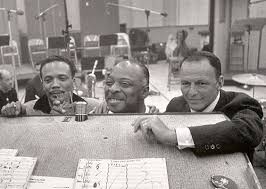
Everything comes together to make the music a perfect miniature of the brassy and confident music of its time. In the crowded Copa Room there’s the legendary Count Basie Band. Fronting it is a young but effective Quincy Jones, who has arranged the charts to show off the the legendary group assembled long ago by another “kid:” this one from Red Bank.
Jones, Basie and Sinatra Pinterest
And then there’s the song, a once-placid ballad written thirty years earlier by Rogers and Hart, but reborn to become the perfect vehicle for a singer in complete control. Frank Sinatra’s musical instincts were never better: a mixture of Rat Pack swagger and his total mastery of the tricky mechanics of jazz phrasing. At times ahead of drummer Sonny Payne’s rock solid beat and at times behind, it all adds up to a moment capturing musicians at the top of their game.
You can doll-up the 140 character/20-word limit as “microblogging.” But that term hardly does justice to the vacuous sneering this social media form has unleashed into our national discourse.
Over the years pundits have been fond of identifying the chief villains responsible for creating our seemingly hardened political life. At least in terms of national politics, a host of problems have been identified that have undermined American democracy. Take your pick: the short eight-second sound-bite common to television news, the tendency of the press to cover campaigns like horseraces and poker games, too much money in the process abetted by the 2010 Citizens United Supreme Court decision, the growth of television attack ads that hardly mention the candidates that pay for them, or the decline of the conciliatory impulse as a candidate virtue.
But if I had to pick only one irritant of the American body politic in this election cycle, it would be the cancer of Twitter as a means of making and setting news agendas. You can doll-up the 140 character/20-word limit as “microblogging.” But that term hardly does justice to the vacuous sneering and sloganeering this social media form has unleashed into our national discourse. It may be harmless for private users. But it has become a bludgeon used by too many campaigns.
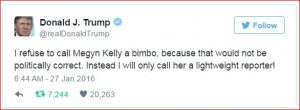
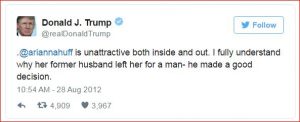
Twitter creates two fundamental problems. The first is that it forces a communicator to stand out quickly, usually by texting intellectually dishonest and hyperbolic assertions: features we have gotten to know to well because of the Donald Trump campaign. Simply speaking, the format makes less likely any kind of thoughtful interactive discourse, often encouraging the rankest kinds of under-qualified claims. A Twitter account can be like an arsenal of bombs dropped from drones. Each rhetorical explosive is lobbed at a distance that saves the sender from having to answer a counter-response. As a means to bypass the media, Twitter is a campaigner’s dream.
The second problem is that too many in the press love these text feeds. If you happen to be a lazy or overworked reporter, you need reach no further than the Twitter feed of the campaign you are covering. All of the provocative quotes you would like to get from the candidate are there, calculated to be as subtle as a snowball in the face.
Better yet, quotes from Twitter usually come as easy building blocks for a story built around the hackneyed idea that journalism needs to feature conflict. Charges made on a feed are easily matched up to counter-charges from a competing campaign that is monitoring the competition. Paste together these shouts into the ether and you have a story without ever having to consider a full stump speech. This process allows the impression that the essential press-politician equation is in tact. More realistically, the impression is more illusion than reality. A politician can “speak” to the press without holding a real briefing where follow-up questions might get asked. And a reporter can go home at a decent hour without the inconvenience of having to show up at a campaign event.
To be sure, this kind of ‘campaign by proxy’ matches the ways we now live. Texting is our distraction and obsession. So we hardly notice that the press/politician dialogue that has traditionally been an essential part of our democracy has been muted.